Please read VFP Director Mike Ferner’s request for support for Senior Airman Larry Hebert and take part in this simple action of support. You can read the Letter of Support here, which includes an excellent direct explanation of how US arms sales and direct support to Israel is in violation of US law. Don’t forget to take action with an email today!
To: All members and supporters of Veterans For Peace From: Mike Ferner Re: Letter of support for Larry Hebert, Senior Airman, USAF
I’m writing to ask every member and supporter of VFP to take a minute and send a letter of support on behalf of Larry Hebert, VFP member and Senior Airman who took a month’s leave from his duty station in Rota, Spain, to start a “Fast for Gaza” in front of the White House.
Larry could no longer tolerate his duty after Aaron Bushnell’s sacrifice opened his eyes to Israel’s genocide in Gaza, funded by our taxes. He followed his conscience and began his fast on Easter Sunday, intending to continue it while he was on leave.
His command cancelled his leave before the month was out and ordered him back to Rota, where he is facing an uncertain future. VFP has retained one of the country’s best G.I. rights attorneys to represent him.
Please do this now before your busy day gets ahead of you. It will make a lot of difference to Larry and to many other active-duty service members who need to know we will support them when they follow their consciences.
1) Email Larry’s commander, Colonel Charles D. Cooley, Wing Commander, 521st AMOW @ M-RO-NAVSTA_Coastline@fe.navy.mil . Cut and paste the Letter of Support into your email.
Veterans of all ages and eras will recognize the truth in former VFP Board Member Michael Prysner’s powerful speech. While the specifics of these wars may have changed, the call to recognize “Our Real Enemies” remains a powerful statement of purpose.
Palestinians search for casualties under the rubble of a building destroyed by Israeli strikes in Khan Younis in the southern Gaza Strip, October 17, 2023. REUTERS/Mohammed Salem
In the closing days of 2023, after more than 80 days of near-continuous Israeli bombing of one of the most densely populated areas in the world, South Africa filed genocide charges against Israel in the World Court for its response to the Oct. 7 Hamas raid in the Occupied territories along its border.
According to the Israeli newspaper Haaretz, the Israeli State Attorney’s office has warned the Israel Defense Forces chief of staff there is real “danger” Israel will be ordered to cease its attack.
The document makes clear that Israel has made no effort to minimize civilian casualties or choose targets based solely on military value. At the time of its filing, more than 21,000 Gazans had been killed, the great majority of deaths being women and children. Most of the men killed are likewise noncombatants.
Israel has destroyed at least 60% of the homes in Gaza and displaced 85% of its population.
The military uses 2-ton bombs in residential areas. This weapon has rarely been used since Vietnam, and never in densely populated areas. While these unguided bombs have a kill radius of up to five city blocks, Israel has admitted using them to target single terrorists. Multiple such bombs were dropped on one refugee camp in a single attack.
As stated in the charges, Israel has killed civilians “in their homes … in hospitals, in United Nations Relief and Works Agency schools, in churches, in mosques. … They have been killed if they fail to evacuate, in the places to which they have fled, and even while they attempted to flee along Israeli-declared ‘safe routes.’”
The only designated safe area left is a desolate, trash-strewn beach with no provisions to shelter any of the nearly 2 million Palestinians made refugees by the relentless assault. Statements by Israeli advisers, officials and the military indicate that the intent was to drive the population into Egypt. Though Egypt has not cooperated in this final act of ethnic cleansing, the assault continues.
Meanwhile, an average of 115 children daily die while thousands are left orphaned, limbless and otherwise permanently disabled. All suffer unimaginable psychological trauma from ceaseless violence, hunger and fear.
Israel has targeted not only hospitals, but ambulances and health care workers. Destroying the health care system is one component of the finding of “inflicting conditions of life intended to bring about their destruction as a group.”
Restricting food so severely that 50% of the population is starving, embargoing critical medical supplies, and poisoning the water supply to the point that there is almost no drinkable water, leading to the threat of cholera epidemic, are others.
An essential element in proving genocide is establishing intent. While generally difficult because most states are careful not to make incriminating statements, many Israeli military and political leaders have freely made public statements indicating genocidal intent.
In one example, when referring to how Israel was going to respond to the Hamas attack, Netanyahu referenced the Biblical story of Amalek, in which Israelites are told, “Spare no one, but kill alike men and women, infants and sucklings, oxen and sheep, camels and asses.”
In another, Defense Minister Yoav Gallant justified cutting off food, fuel and other necessities to the helpless population with the statement, “We are fighting human animals, and we are acting accordingly.”
It’s time that those who object to the use of the word “genocide” in relation to Israeli actions stop and take a look at the voluminous evidence cited in the 85-page petition.
History does not judge kindly those who refuse to recognize and intervene to stop an ongoing genocide, whatever their rationalizations.
USS Decatur (DDG-73) conducts a launch of the SM-2 missile, at a cost of at least 2.1 million dollars.
Expert estimates put the cost of repelling attacks by Houthis in the Red Sea and attacking sites in Yemen at over 20 million dollars per day. Imagine the goodwill that could have been bought with that money. We, as Americans, could have built hospitals, trained doctors, paved roads, and provided hope for peoples in such distress that they see no better option than to get attention through pointless attacks.
We see the same in Palestine, where a people who have been systematically deprived of any hope lash out irrationally, and are met with millions of dollars of worth of destruction and death. Instead we could show compassion for the circumstances these people. A fraction of the cost of these missiles could have addressed the concerns of the Houthi rebels; a fraction of US aid to Israel could have given Palestine and given people the hope they need. Depriving people of hope causes terrorism and war, while investing in people makes everyone better.
Every missile spent costs real taxpayer dollars, and buys nothing but death and the fury of already hopeless people. But investing in people, here and abroad, has always paid back dividends in security and hope for everyone. We must stop the attacks, and spend similar amounts on helping the people who see no choice but to cast America and its allies as an enemy.
It is the right thing to do, and also costs less for the taxpayer.
–Joel Inman, VFP Linus Pauling Chapter, former US Navy sailor in the Red Sea
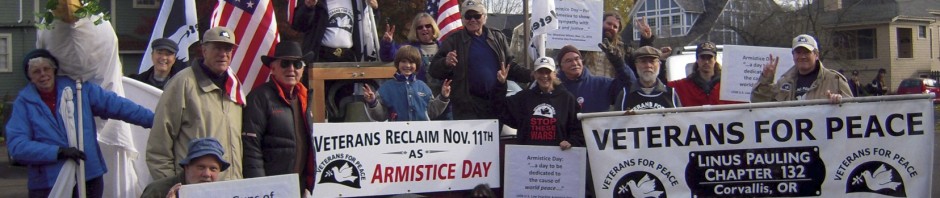
We were there to let people know that there are veterans who prefer to wage peace. Our message, prepared by Rick was read at each of five reviewing stands:
“The Linus Pauling Chapter of Veterans For Peace has been waging peace since 2006. We encourage everyone to remember that Veterans Day started out as Armistice Day, a celebration of the peace that followed World War I, the ‘“War to end all war.’
This day was set aside to remind us of the costs of war. Knowing the great price that combat veterans pay, we are dedicated to making sure that our service members are not put in harm’s way unnecessarily.”
Eight of us paraded. Rick distributed flyers. Denis and Joel carried our banner. Charles Maughan and his partner followed us in his jeep. Two other VFP members took up the middle. Court carried the sign below, the cover of a book about William Stafford’s conscientious objector experiences and peace thoughts organized after his death by his son Kim. Stafford won the 1963 National Book Award for Poetry and other writing awards. He is a widely known Oregon poet who taught at Lewis and Clark College.
There was little mention of the parade in local news reports, and none mentioned VFP or many of the 150 entries in this year’s parade. Most entrants were engaged in promoting the brand of their organization, or having a little fun as a group or team. Crowd size, based on the length of the parade route, about a mile, and a density estimate, resulted in an estimated 4500 parade attendees.
Our participation in the parade went well. We were pleased to find no pushback from parade organizers over our message, despite it being as close a political statement as we saw in the parade. We marched by people who lined Lyon Street from the junction with Hwy 99E to SE 2nd Avenue and then up Ferry Street to SE 4th Avenue. Half the crowd were children mostly stimulated by candy thrown to them. Most parade watchers paid little attention to us, or others near us in the parade. Thus, our biggest problem was getting people’s attention. Walking back and forth across the street carrying the sign and offering flyers did attract people interested.
To get people to engage the sign or receive flyers, making eye contact as much as possible worked. For those who saw the sign, about a third acknowledged it positively. No one gave a negative gesture. Women were more responsive and positive than men. Few young people took the time to read the signs or banners, so we recognize the limited capacity of our parade participation to start conversations or change minds, especially in the young.
Unless you’ve been out of town since October 7, you know that Corvallis peace and human rights activists have been on the streets calling for justice for Palestine since it became apparent that Israel’s response was not merely disproportionate, but genocidal in its methods. Veterans For Peace has been represented at the weekly demonstrations at the Courthouse sponsored by the newly reconstituted OSU chapter of Students United for Palestinian Equal Rights (SUPER) and Corvallis Palestine Solidarity (CPS), and you are invited to join us.
VFP members were present at the recent Corvallis City Council meeting at which members of the public spoke in favor of a resolution in support of the innocent civilians in Gaza who are being systematically slaughtered by Israeli carpet bombing of their open air prison, where there is no safe place to hide, including in hospitals that have been systematically targeted by the IDF. This is one element of genocide that international lawyers and human rights workers are citing in making the case that Israel is guilty of crimes against humanity. This is in addition to the fact that Israel is indiscriminately bombing the densely crowded population of Gaza primarily using weapons with the killing power of 500 tons of TNT or more, so is clearly not making any effort to restrict civilian casualties. In the face of multiple statements of genocidal intent by Israeli leaders, the onus is on the defenders of Israel to disprove these well-documented allegations.
Also present at the meeting were members of the Jewish community who spoke both for and against the resolution. The majority of these, many of them from the Beit Am synagogue, were opposed to the resolution for various reasons. I know from private discussions that there is a pervasive atmosphere of fear among the Jewish members of our community because of the visceral and public reaction to the genocide that they believe is directed at them as Zionist Jews, some of which came out in testimony. In fact, one of these friends I spoke to said that supporters were chanting “Kill the Jews!” when as nearly as I can determine, the only chants that could have been interpreted that way were those of “Palestine will be free from the river to the sea!”
For those who may not realize it, this chant is a call for equal rights in Palestine, whether through a one-state solution or, as some believe possible, a federation. It predates the Nakba. Palestinian historians state that it originated when the UN proposed to partition the historic lands of Palestinians in 1947, giving 56% of the land to the Zionist immigrants despite their owning only about 6% of the land. This was despite the fact that the Delegation of Arab States had proposed a unitary state with equal rights for all in 1946.
I was particularly impressed by the testimony of one young Jewish woman who spoke in favor of the resolution, stating that Zionism was not consistent with her Jewish values, something she only learned after researching the actual history of Israel on her own. This study convinced her that she had been systematically been misinformed about the history of Israel, including its founding through an act of massive ethnic cleansing of the indigenous non-Jewish population (i.e., the Nakba). She spoke passionately of her outrage at the way that Palestinians continue to be violently ethnically cleansed and particularly at the genocidal methods being used to do so in Gaza. I am looking forward to meeting her at the next demonstration, where I hope I can convince her to become a member of the new Mid Valley Jewish Voice for Peace affiliate that will soon become official.
L’chaim! (To life)
Rick Staggenborg, MD President, VFP Linus Pauling Chapter
Veterans For Peace is an organization of former soldiers and allies who know too well the costs of war – the obvious, visible wounds; the unseen wounds that curse us and our families for generations and the cost to society of maintaining a military larger than the next ten nations combined. Bitter experience taught us that war is insanity and suffering.
We oppose all targeting of civilians. We denounce Hamas’ attacks on Israeli civilians and deplore Israel’s crushing response in Gaza. We also recognize this war did not start last week, it has gone on for decades. Over $150 billion of our tax dollars have provided Israel unlimited weaponry and diplomatic cover has allowed it to expand its occupation such that 16 years ago former President Jimmy Carter clearly labeled it apartheid.
Our government fans the flames beneath the pressure cooker of occupation and our taxes make us complicit. We should not pretend shock at a violent response after Palestinian homes are destroyed to make way for Israeli “settlers” and Gaza is locked down, year after year, by a draconian air, sea and land blockade. History is defined by when you start the clock.
In the war of competing propaganda, we recognize that U.S. officials fabricate incidents for corporate media consumption, such as President Biden claiming he saw photos of beheaded Israeli children. Hours later, as reported by news outlets from the Palestine Chronicle to Business Insider, a White House spokesperson had to “walk back” Biden’s claims. But just like the Bush administration claims in 1991 that Iraqi soldiers threw Kuwaiti babies out of incubators, once the lie is out, the truth rarely catches up.
This cycle of violence, coupled with the reality that war is an uncontrollable force with its own agency and purposes, results in the terrors we witness.
Neither side has a military path to victory, which is why we strongly oppose our government’s plans to send troops, aircraft carriers and more munitions and President Biden’s promise to fully support Israel’s assault on the people of Gaza. We support a ceasefire, negotiations and release of prisoners from all sides.
Only a political process will dismantle the apartheid system, answer the grievances of the Palestinian people, create a democratic system that provides rights for all the people of Israel and Palestine, and finally bring lasting security and peace. Without that political process, the cycle of violence will magnify, dooming more generations of Israelis and Palestinians.
We lift up the words of our brother and sister military veterans, both Palestinian and Israeli, members of Combatants for Peace:
“Ourhearts are with all of the victims and their families, and we hope for the safe return of those held captive, and for the safety of the civilians trapped inside Gaza…Together, we must retain our humanity, and value all life as sacred and cherished…The only solution is ending the occupation, uniting Israelis and Palestinians and focusing our collective efforts on achieving peace.”
October 12, 2023
For more on VFP, Israel-Palestine Policy, and our collective efforts on achieving peace, visit VFP at https://www.veteransforpeace.org/.
The Linus Pauling Chapter is returning to the Linn County Veterans Day Parade!
After an absence of several years, VFP will be represented in the annual Veterans Day parade in Albany that is said to be the largest such event west of the Mississippi.
We consider this a valuable way to demonstrate to those who attend this event that not all veterans equate supporting the military with supporting US wars waged for empire. Our theme will be “Take Back Armistice Day,” which refers to the origins of this holiday in the antiwar movement following WWI. We’ll have a banner with that message and hand out literature on the way.
To have the greatest impact, we are seeking to have supporters march with us. If you are able to march from Queen Avenue Near Highway 99 to downtown, please let us know and ask others to join you. The check-in area is one block off Queen SW on Industrial Way. While the parade does not start until 11 AM. the earlier you arrive the more time we will have to socialize before it begins.
To RSVP or for more information, text Rick Staggenborg at 541-217-8044
VFP:LP is proud to support this annual event commemorating the lives and culture lost in the 1945 US atomic bombing of Hiroshima and Nagasaki, Japan. Date Saturday, August 5th, 6:30 PM at Riverfront Park in Howland Plaza on 1st and Madison Street. The event features traditional Japanese koto music, displays, and origami paper crane folding. The program begins at 7 PM featuring Corvallis Mayor for Peace Charles Maughan and Kamil Khan of Oregon Physicians for Social Responsibility. VFP encourages warriors for peace, allies, and friends to join us in this important event.



 Veterans For Peace, Linus Pauling Chapter